In the last installment of this series, we learned about how political choices by specific counties are driving a $30M shortfall that threatens service cuts. These cuts are part of broader flaws in Metrolink governance that have stymied a more ambitious vision since its founding, and threaten to curtail Metrolink’s most ambitious plans. But the current crisis offers an opportunity for change.
Metrolink Service and Ridership
Metrolink consists of a 547‑mile network across six counties. The 7 lines have varying levels of frequency and reliability. Prior to the March 2026 emergency service cuts, the San Bernardino Line had half-hourly peak service, the Antelope Valley Line had hourly service until 11:39 PM, but other lines had less frequent service. Weekend service is less than hourly systemwide, with no service at all on the Riverside Line, only two trains per day on the Inland Empire-Orange County Line. Lower levels of weekend service persist even though weekend travel demand is 82% of weekday travel demand.
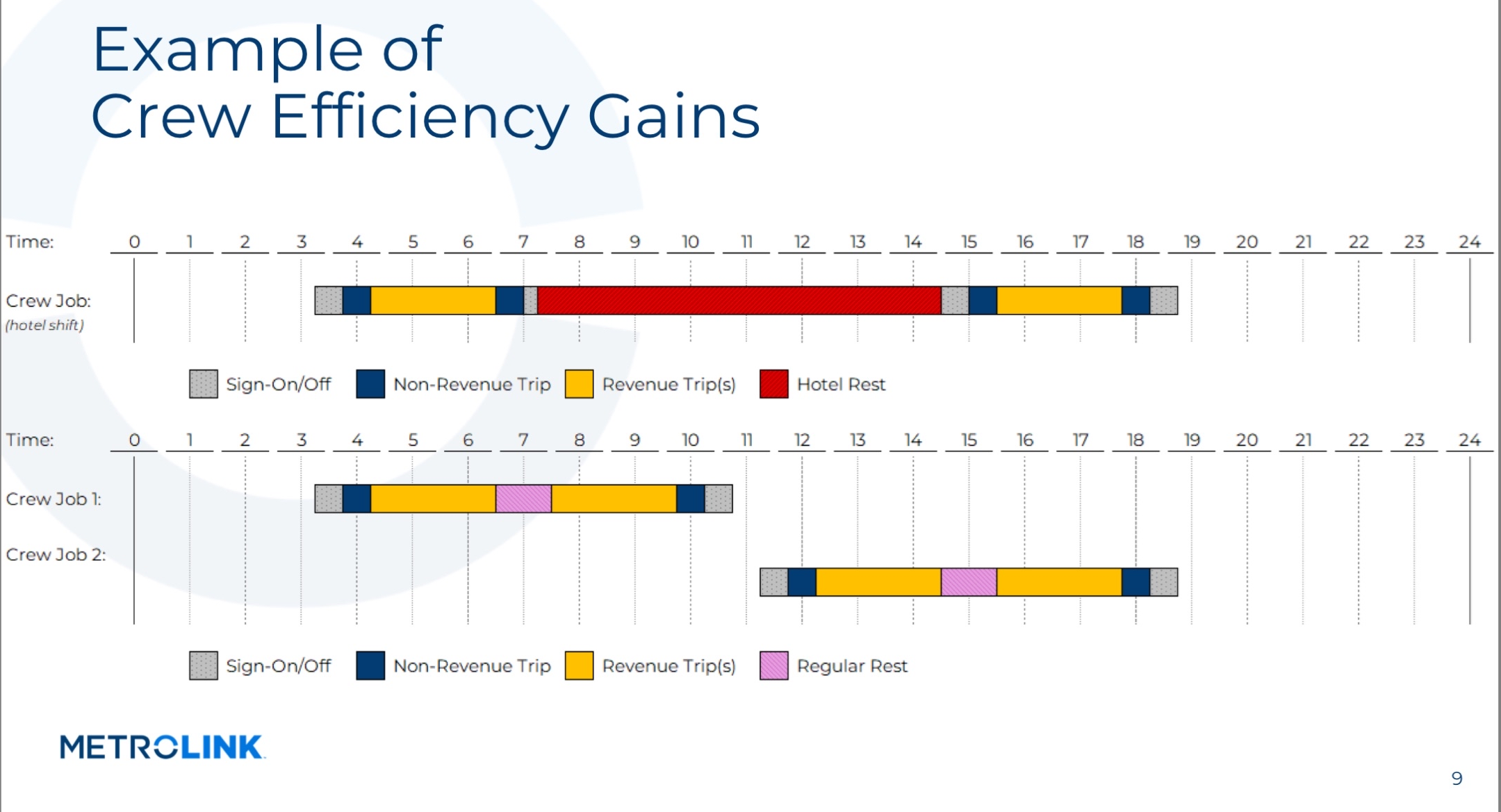
Current levels of service came about as part of Metrolink Reimagined program to move to the regional rail model of service, with all day, clockface service and pulsed scheduling to aid transfers. Regional rail is an international best practice that provides cost effective operations and schedules that fit the post-pandemic reality of remote work, enhanced leisure travel, and nontraditional work schedules. All day service improves efficiency of crew uses, such that future planned service improvements would increase train miles by 93% while only increasing needed support by 21%. Metrolink is also shifting its schedule to clock face, repeating intervals (e.g. 12:03, 1:03, 2:03 departures from LA Union to Santa Clarita) that are easier for riders to plan for.
The move to regional rail appears to be paying off - Metrolink broke all time weekend ridership records in March 2025. Between 2024 and 2025, Metrolink saw the second highest percent increase in ridership of any regional rail agency nationwide, behind only Caltrain, which electrification made a resounding success.
But these schedules are now at risk, and the expansion of Metrolink Reimagined to weekends, planned for 2028, may now never happen. Unless Metrolink finds more revenue, they will revert to peak-only schedules and cancel weekend service improvements - increasing costs per rider, and failing to serve increased off-peak demand that will be generated by the World Cup and Olympics. This threatens to send Metrolink into a “death spiral” of declining ridership, further deficits, and cuts. This crisis is a product of Metrolink’s uniquely decentralized governance structure, which is not meeting the moment.
Metrolink's uniquely decentralized governance
Metrolink as an operating agency is governed by directors selected by its five county member agencies (San Diego has ex officio representation only). These are all local elected officials from city or county governments for whom service on the Metrolink board is one of several part-time responsibilities that entitles them to a per diem.
Unlike regional rail governance in other developed countries or even states like Utah or soon in Colorado - there is no requirement that the board members have experience in planning, transportation, finance, accounting, law or construction. There is no requirement that the board members regularly use the system.
It would be a mistake to think that Metrolink’s governance structure was developed after deliberate consideration about long-term best practices. The agency was conceived in 1989 after Southern Pacific and Santa Fe track in Southern California was put up for sale. The various counties engaged the railroads in negotiations without first having an organization or structure. State legislation - SB 1402 - was passed to facilitate voluntary planning and coordination by the counties of a rail network. Only after initial bargaining acquisition of ROW and trackage rights by individual counties and purchase of railcars by LA County in 1990, did the counties come together into a formal joint powers agency: the Southern California Regional Rail Agency dba Metrolink, in 1991.
That Metrolink and its constituent counties were able to launch revenue service by 1992 is a testament to the hard work of public servants and county political leaders. The willingness to move forward without having all the governance questions worked out was probably necessary for the system to get off the ground. But as Metrolink enters middle age in 2026, it is clear that many of the weaknesses embedded into that loose governance structure have hamstrung it from realizing its full potential.
County ownership of ROW devolves management of capital programs to local county transportation agencies (LA Metro, SBCTA, RCTC, OCTA, VCTC), a problem for their capital program, as we’ll see in upcoming parts of this series. But operations funding is also devolved to counties, with each providing a different contribution based on local transportation sales tax measures. This structure means that systemwide investments require the cumbersome approval of five different boards, and means that local priorities drive nearly all budgetary decisions. For instance, Riverside County wanted to increase service on the IE-OC line, but was denied by Orange County. Any operating surplus must be returned to the counties, which recently prevented Metrolink from using a surplus to reupholster worn seats. And that inability to coordinate among counties doomed the widely-requested addition of Wifi to Metrolink. Clearly, this structure is impeding the everyday function of the system.
The Curent Crisis

Metrolink’s budget crisis is driven by three things: less-than-projected ridership, rising costs, and less operating revenue. Metrolink’s structure exacerbates all these issues.
Metrolink’s lack of coordination hurts ridership. The Metrolink system has nominal integration with local transit. Each of the five counties has a different payment system for local transit, none of which are usable on Metrolink. LA Metro provides free transfers but other transit agencies lack clear policies or mechanisms to facilitate integrated ticketing. Although Metrolink has recently shifted to a clockface schedule that facilitates local transit schedule integration, connecting transit agencies have not adjusted their schedules to take advantage of this development. For instance, the Omnitrans bus connecting Riverside to the San Bernardino Line stops running before Metrolink does, and Omnitrans and RTA provide no service on holidays, unlike Metrolink.
In the Bay Area, the Regional Network Management Council has provided a fora for regional rail operators BART and Caltrain - now running on clock face schedules - to coordinate schedules with local transit. No similar body has emerged yet in Southern California. This lack of fare and schedule coordination surely suppresses ridership.
Local governance also is responsible for operational inefficiencies. Increased costs for sheriff's contracts are a major driver of Metrolink’s increasing expenses. San Bernardino County spearheaded the practice of using sheriff deputies for fare enforcement, duplicating the work of conductors. San Bernardino County has also pushed for systemwide adaptation of hydrogen trains (currently only one is in service on the Arrow line), a practice that could exacerbate operating deficits in the future due to the high and rising cost of hydrogen fuel. Inability to coordinate between counties is a major barrier to further cost-saving and ridership-boosting investments like systemwide electrification and level boarding, as we’ll see in the next part of this series.
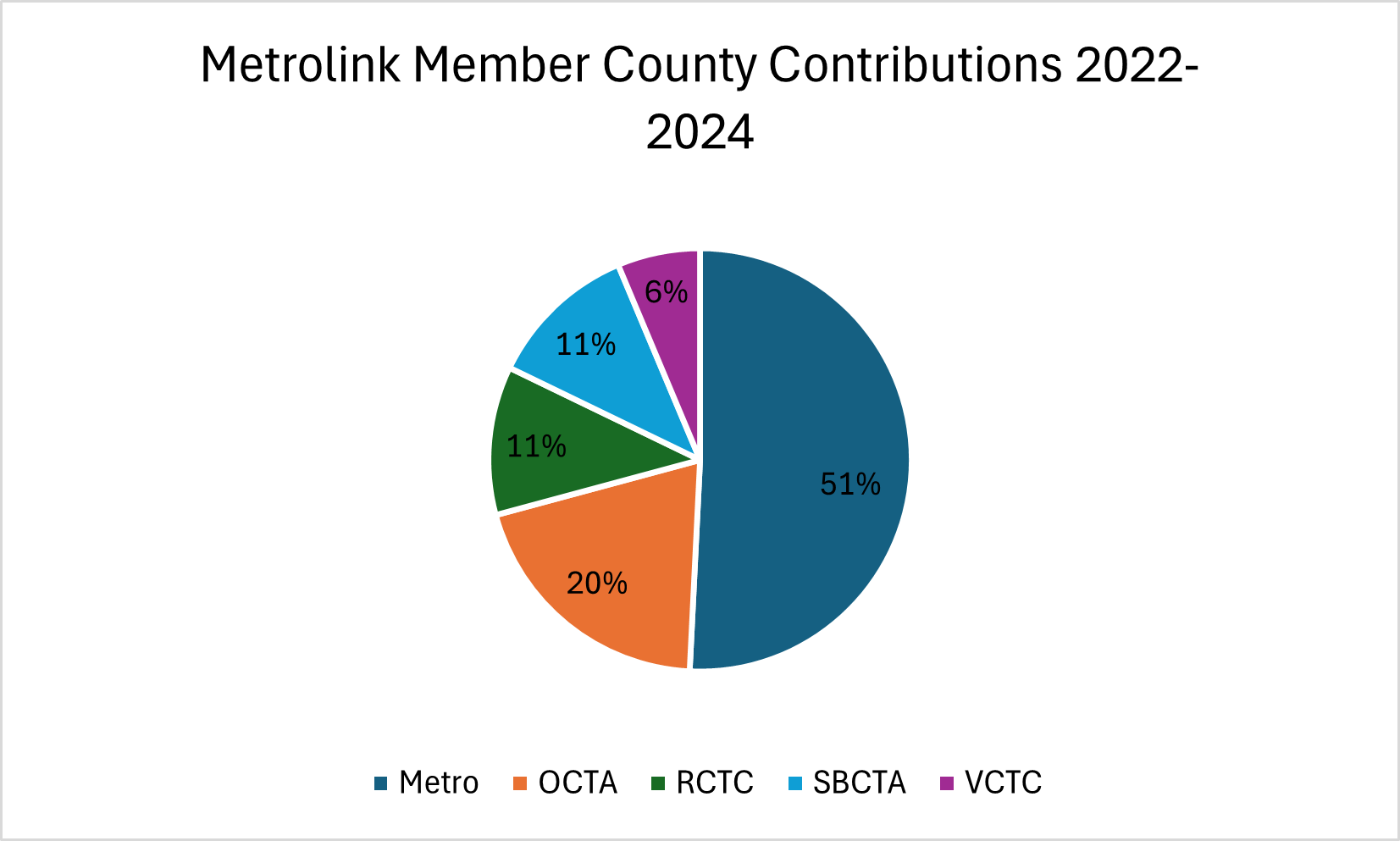
Most critically, in 2026 LA Metro and OCTA have proposed to reduce their operations support for Metrolink by a total of $9.5M annually, ongoing through 2030. Meanwhile LA Metro is continuing to advance SCORE program capital projects to increase capacity. When two counties control most of the money and can make unilateral cuts, system-wide goals suffer. Metrolink needs a healthier mix of state and local funding that is controlled by the Metrolink board, not local interests - both to avert the fiscal cliff, and to continue to advance systemwide service modernization.
In the immediate term, Metro and OCTA must reverse their misguided cuts - contact them here! Moving forward, the state must step in to provide sustainable, consistent operations funding (California funds transit less than many other states). And as a first step to governance reform, counties should come together to provide regional funding that’s not at the discretion of hyper-local interests.
Read on for the next part of the series, where we’ll discuss how Metrolink governance impedes capital modernization that is essential for providing more service.