In previous posts in this series, we discussed Metrolink’s imminent budget crisis and its struggles to maintain and expand service and ridership. These are exacerbated by its inability to deliver capital improvements, from basic maintenance to ambitious modernization programs like electrification.
Given the size and age of the network, there is a large backlog of state‑of‑good‑repair needs like track, signals, and bridges. Global best practice is to pair renewals like this with improvements to electronics and infrastructure that enable better or expanded service in what’s known as a modernization program. Mobilizing external construction, engineering and project management resources for a small project is expensive. North America prefers to do piecemeal repairs rather than a full renewal. Renewals can also be combined with new infrastructure to become a modernization program. Unfortunately the diffusion of planning and project delivery to county members makes the pairing of joint renewal and capacity and other enhancement projects challenging.
Each county government is incented to treat renewals or enhancements as discrete projects. But whether the railroad is in good condition or able to provide 2 trains per hour may be dependent on multiple counties executing multiple projects across time horizons. LA Metro may have the resources and know-how, but may de-prioritize capital projects for Metrolink for local, state or federal funding in order to push forward Metro rail transit projects. Conversely, Orange County may de-prioritize inland relocation of the San Clemente section of the main line because it lacks the capacity or political will. In the end all riders lose under this fragmented regime as county‑by‑county funding and political disparities complicate systemwide planning and program delivery.
SCORE Capacity Program is struggling
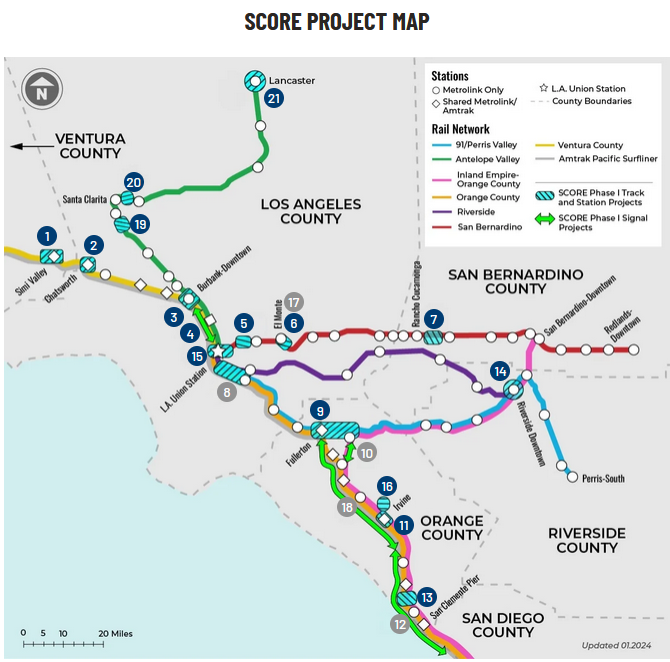
The SCORE program (Southern California Optimized Rail Expansion) is a capacity program that was developed to deliver 2 TPH base level service across the network in preparation for the 2028 Olympics. This would provide Metrolink riders a base level of frequency equivalent to Caltrain in the Bay Area and set the stage for high-speed rail from Las Vegas and San Francisco.
Typical capacity improvements like double‑tracking, sidings and signalling help provide the capacity and reliability in the network. It also includes large ticket items like LinkUS thru-running at Union Station, which reduces dwell times by 15 minutes, allows more regional service patterns and supports California High-Speed Rail.
SCORE’s 2017/2018 costs were pegged at $10 B across the network. While some efforts were made to market the program to Southern California leaders, the state of California and the Federal government, there were no political champions - due in large part to the fractured governance.
As a result many of the SCORE projects have stalled out due to planning, funding and project delivery challenges (discussed more in other CER publications). Antelope Valley Line Improvements were awarded partial funding before design was complete but then suffered from extractive demands from utilities. Sidings along the Ventura Line have been held up by Union Pacific design review. The Serra Siding in Dana Point is a straightforward project within the existing ROW that cannot advance due to the power of a dozen or so NIMBY homeowners flexing power before the Orange County Board of Supervisors.
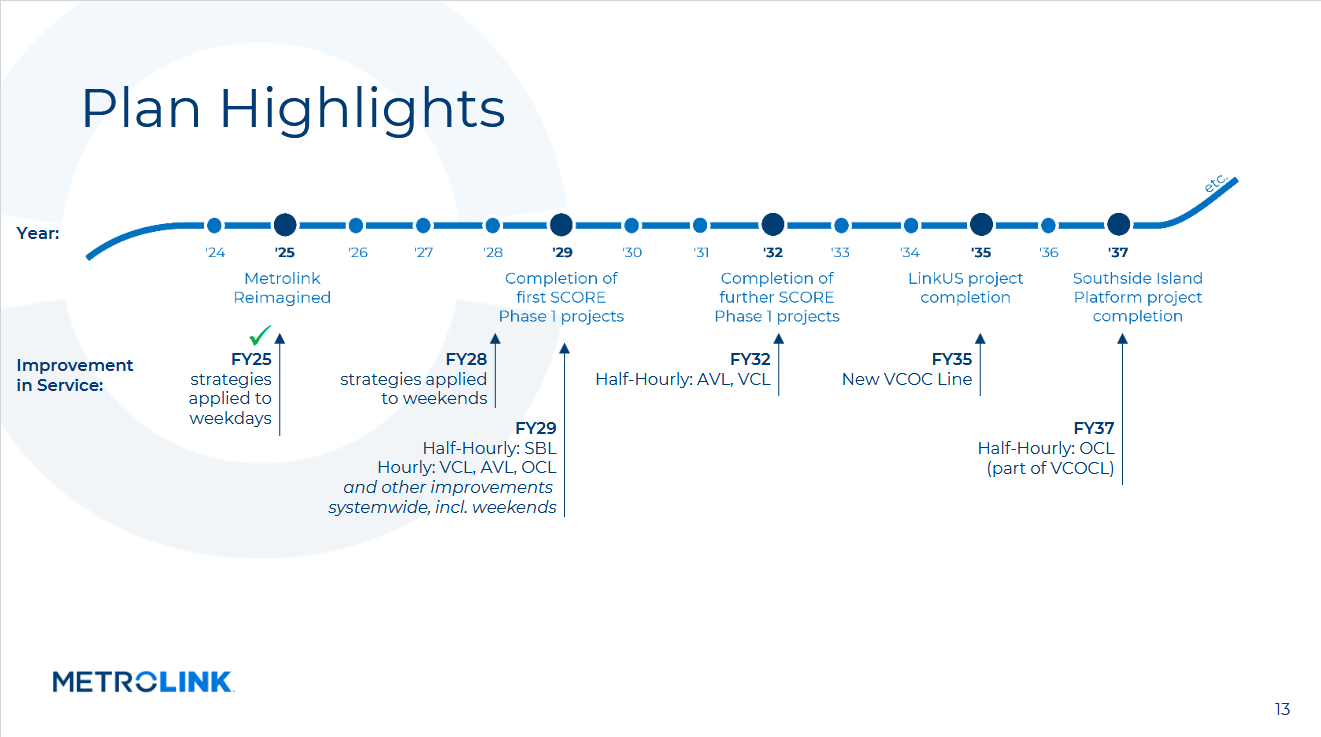
Given these headwinds, the SCORE Program will deliver little service improvements ahead of the Olympics. Full systemwide 30 minute service will not be delivered until 2037, nearly 10 years late. And Metrolink’s current budget crisis throws even these much-delayed improvements into question - will Metrolink even be able to fund the service? London, Paris and Tokyo did not allow hyper local governance and fractured funding to derail their transportation improvements for the Olympics, but Southern California leaders chose to do exactly that.

Governance holds back electrification
At the same time Metrolink initiated its SCORE program in the mid-2010s it also directed staff to identify zero-emissions technologies for rolling stock modernization.
Staff initially considered gold-standard rail electrification, but starting in the early 2020s shifted towards hydrogen options - driven largely by San Bernardino County, who had spent years developing their own first in the nation hydrogen train service. CER has extensively covered the challenges with H2 trains and the vast public and private coalition that has pushed these immature technologies at the expense of high-quality and reliable service. Should single counties effectively make rolling stock decisions for the entire system?
As subsidies to hydrogen equipment, production and infrastructure have dried up and commercial pricing of hydrogen continues to be volatile, operators have taken a second look at batteries and in limited cases dual-mode battery/catenary trains. As the California High-Speed Rail Authority 2026 Draft Business Plan considers electrifying parts of the Antelope Valley Line and mainline between LA Union Station and Anaheim (maybe Irvine too?), there’s a good case for Metrolink to embrace a program of gradual electrification for its services.
The model for electrification of Metrolink should not be CalMod - the electrification of Caltrain - but instead rolling enhancement programs in Scotland, Germany and Italy. While the benefits of Caltrain electrification are undisputed - 25% reduction in travel times, increased reliability and decreased operating costs - the planning and delivery of the improvements left much to be desired. While the reasons are myriad, a key contributor is the paradigm to treat electrification as a one-off project rather than a program of modernization.
A modernization program involves developing service goals, scoping capacity, electronics and equipment decisions to meet those goals and steadily developing projects that could be funded as rolling enhancements. Specifications are standardized rather than bespoke - which creates efficiencies for suppliers and the public. Projects are funded and realized incrementally and tied to service improvements.
But can Metrolink even deliver electrification under its current structure? The SCORE model of capital projects managed as one-offs by counties with little in-house expertise or political capital and high deference to local issues seems at odds with a rolling program. Caltrain, which successfully electrified, did not leave it up to Santa Clara and San Mateo to implement different segments - the agency, which controls the right of way, did it. Similarly, capital projects in Italy and Scotland are not led by local jurisdictions, but by state entities of sufficient size to hire staff and retain institutional knowledge.
Without reforms, Metrolink may limp along running expensive, unreliable diesel and hydrogen trains, failing to provide service fitting a megaregion of 17 million - and that’s if it’s not killed by the transit death spiral sparked by service cuts. To successfully implement electrification, Metrolink needs a single infrastructure manager - like Caltrain that is positioned to implement project delivery best practices.
In the next part of this series, we’ll discuss urgent opportunities for reform - and how these opportunities are being undermined by the state.