Is SNCF the skeleton key to California High-Speed Rail’s problems, or just another private contractor? We take a deep dive into the history of the French high-speed rail operator’s long relationship to the project to find out what really went wrong with CAHSR.
Two articles in July and August 2026 have come out attacking California High-Speed Rail for not heeding the advice of French high-speed rail operator SNCF to attract private investment. Joe Matthews (SF Chronicle, 7/26/26) and Dan Walters (CalMatters, 8/11/26) both criticized CAHSR for this decision from 2010/2011 - 15 years ago and three governors ago when Arnold Schwarzenegger was overseeing the program. By happenstance, both these columnists (longtime friends and critics of CAHSR) had columns appeared as budget negotiations were heating up on next steps for CAHSR. Why are these statewide columnists so fixated on one particular decision with respect to SNCF from so long ago?
This is especially strange because SNCF Voyageurs - the operating company subsidiary of SNCF - signed a Co-Development agreement with CAHSR in June 2026 as the operations lead for the private consortium Momentum Alliance Partners to accelerate high-speed rail development and attract private financing.
If CAHSR failed to listen to SNCF in 2010/2011, and that’s the basis for condemning the project in 2026, you’d think that the fact that SNCF is literally advising CAHSR in 2026 about how to reduce costs and accelerate project development and service delivery would be relevant to pundits?
The SNCF anecdote itself only got traction 11 years after the events transpired. Per Walters: “However [SNCF’s] advice was ignored, journalist Ralph Vartabedian revealed in a 2022 article for the New York Times. SNCF pulled out in 2011.”
This gets at a larger problem with the media and CAHSR. A lot of people are working off very old information about the project. And a lot of the older information they have is not particularly firmly grounded in the historic record.
It’s clear that CAHSR has made plenty of mistakes. Some of those mistakes were related to mismanagement, such as doing work out of sequence and overreliance on consultants. On the other hand some of those mistakes were imposed by external forces - like the ARRA grant mandate that construction start in the Central Valley by 2015. Or the Legislature preventing CAHSR from using Surface Transportation Board preemption for planning the route or failing to provide it streamlined authority for CEQA or 3rd party permitting of utility relocations. Or the legislature failing to provide consistent annual funding sufficient to cover the 2008 projected budget for years - a mistake that was recently rectified with last year’s Cap and Invest deal.

Reforms to HSR since 2010
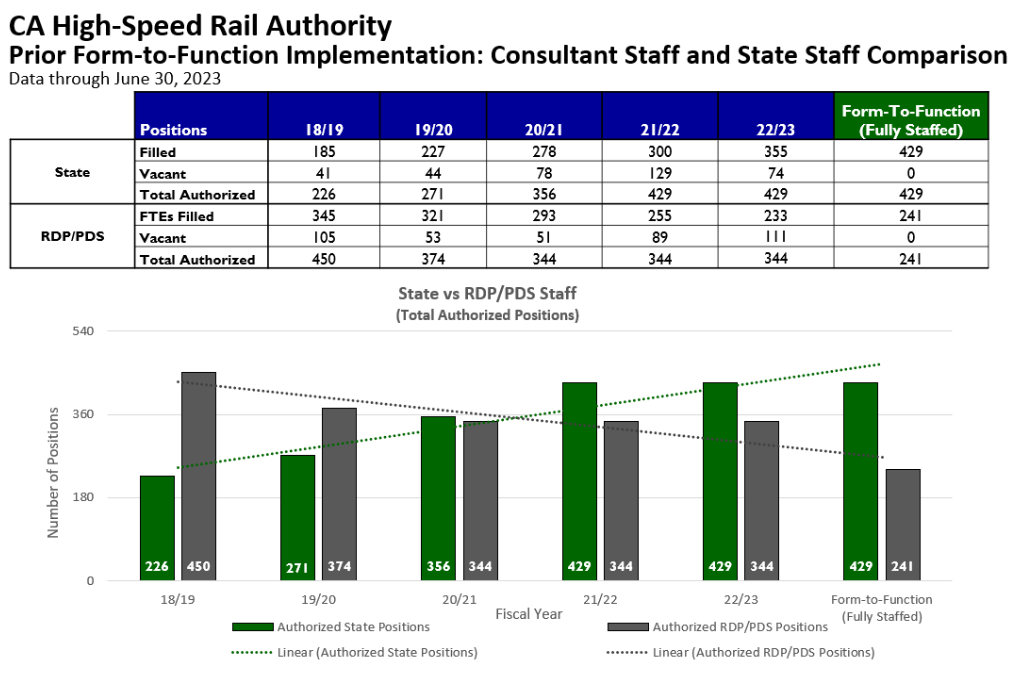
Unfortunately many of the pundits tend to fixate on missteps that are basically irrelevant to the issues facing CAHSR in 2026. For example, in response to a 2018 audit, the Authority shifted to a supermajority share of staff as in-house staff compared to consultants. Audit and inspector general reports have inspired further reforms to ensure work is done in sequence and overseen by the proper staff. Increasingly, CAHSR environmental review, planning, design and engineering staff are taking on work to advance intercity rail projects in Northern LA County, San Diego County and elsewhere so they do not repeat the mistakes of CAHSR in overly relying on consultants.
The environmental reviews? These are all done apart from the nearly complete Los Angeles to Anaheim project section.
The civil work for the 119 mile section in the Central Valley is nearing completion this year in anticipation for the track and electrification contractor scheduled to begin laying track in late 2026.
Looking forward, CAHSR has adopted new models to bring down costs. Starting in 2024 CAHSR began updating its Design Criteria Manual with an aim to reduce the costs and timelines of delivering infrastructure. Prior iterations of the Design Criteria Manual had been written by American consultants with no experience with high-speed rail and deferred to American Class 1 railroad standards for planning of structures and guideways. That meant larger clearances, more conservative grades and higher costs and longer schedules for delivering high-speed infrastructure.
The updated manual reflects European and East Asian design standards for right-size infrastructure for high-speed service, including for rail vertical profile, operating and design speeds, track center spacing and platforms, track geometry criteria, tunnel structures, bridge structures, and earthworks. As an example:
The revised [Design Criteria Manual] allows for a maximum gradient of 4 percent, with a baseline of 3.5 percent, consistent with international standards. This change reduces the need for extensive viaducts and tunnels, leading to substantial cost savings. Modern highspeed rail trainsets are also specifically designed to handle steeper gradients efficiently without significantly increasing energy consumption. In the Pacheco Pass corridor, increasing the maximum allowable gradient could enable a reduction in tunnel length from 15.1 miles to 7.1 miles. In the Tehachapis, raising the maximum allowable gradient could eliminate four tunnels and shorten five others, reducing the total length of tunneling from 10.8 miles to 5.8 miles. These modifications offer considerable construction cost savings while preserving operational efficiency.
-- Supplemental Project Update Report 2025
The outcome is lowered cost and faster schedule for delivering infrastructure and getting extensions into operation sooner; per the 2026 Business Plan: “[t]his resulted in an initial $14 billion in savings for the Merced to Bakersfield segment helping offset inflation cost drivers.” The revised Design Criteria Manual can help further lower costs and schedules for extensions towards the Bay and LA.
Against I-5 Trutherism
Amongst critics, the decision to route towards Fresno and other Central Valley cities rather than along the median of I-5 is the most frequent target , just as the 119 mile project section is nearing completion. What lesson does I-5 versus I-99 provide to policymakers in 2026 given this fact? The hard work of planning, environmentally clearing, designing, relocating utilities, constructing bridges and guideways is now done. Do I-5 truthers (partisans) propose to abandon that work to duplicate it 50 miles to the West?
Many of the pundits have seized on the idea that SNCF allegedly proposed a route along I-5 that would have been faster and cheaper. But this proposal was made prior to the passage of Prop 1A by the voters, which committed to stops in Fresno and other Central Valley locations. That pre-Prop 1A proposal for I-5 was premised on branching to serve Central Valley cities which would have been even more complicated and expensive.
In fact, in 2011/2012 SNCF boosters in California at the time did not even believe SNCF’s pitch to be about the I-5 route. To quote, TransDef, an organization that has sued CAHSR multiple times over differences in program, planning and development decision making:
Note that, despite all the recent talk about the merits and demerits of an I-5 route, the SNCF proposal was not premised on a specific route. It was solely a process to bring in private capital and an experienced operator.
-TransDef, 2012
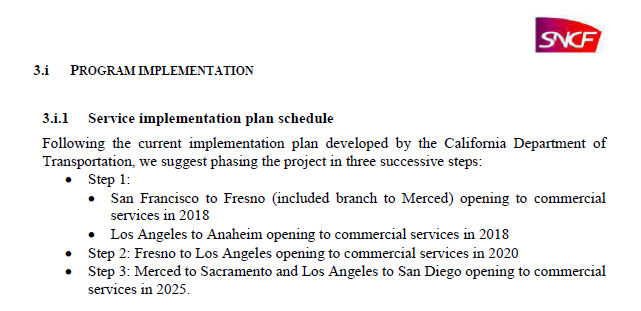
The 243 page proposal from SNCF confirms that it sought to largely follow the Prop 1A route to serve Fresno and other Central Valley locations.
SNCF’s Naive Project Delivery Assumptions
3rd party Cooperation
Looking back at the SNCF proposal with 16 years of experience, there are places where the French firm was overly optimistic about their ability to work through California and American institutions. Many of the places SNCF operates, including its home country of France, have nationalized rail infrastructure and/or operators. American Class 1 railroads, by contrast, are large and oftentimes unresponsive bodies, especially on the topic of accommodating passenger rail. There is no easy mechanism by which CAHSR, SNCF or even the State of California can force UPRR or BNSF to cooperate. This is especially important because shared HSR and conventional rail ROWs are an important component of many high-speed rail corridors, including the CAHSR route. SNCF stated it will seek full cooperation of Class 1 railroads in the design of infrastructure that interfaces CAHSR infrastructure. This is functionally the same ask and agreement CAHSR asked and received from UPRR and BNSF.
Given these considerations it is understandable that, at some point, high-speed infrastructure will interface with existing railroad infrastructure.... The process could be handled as follows:
-
- Construction of high-speed infrastructure.
- Construction on active ROW not requiring relocation of existing track: all appropriate measures will be taken to avoid the impact on current rail operations.
- Exceptional work will be planned long in advance and coordinated with the operator concerned.
- Construction on existing railroad right-of-way that affects the existing railroad alignment: SNCF will seek full cooperation with the current operator through joint design development and common working groups. The design and work will comply with all existing US technical railroad requirements (i.e. AREMA rules) and the infrastructure requirements of the current operator.
- SNCF 2010 Proposal, pg. 49
As an example of the importance of railroad cooperation, the standard practice in Europe for high-speed rail crossing a conventional rail line is to try to cross at a perpendicular angle to limit the length of structures. Where the existing and proposed routing does not allow for a perpendicular crossing, the legacy track will be re-aligned to facilitate a simpler crossing. This makes sense because it is cheaper to re-align a track than build a larger concrete viaduct.
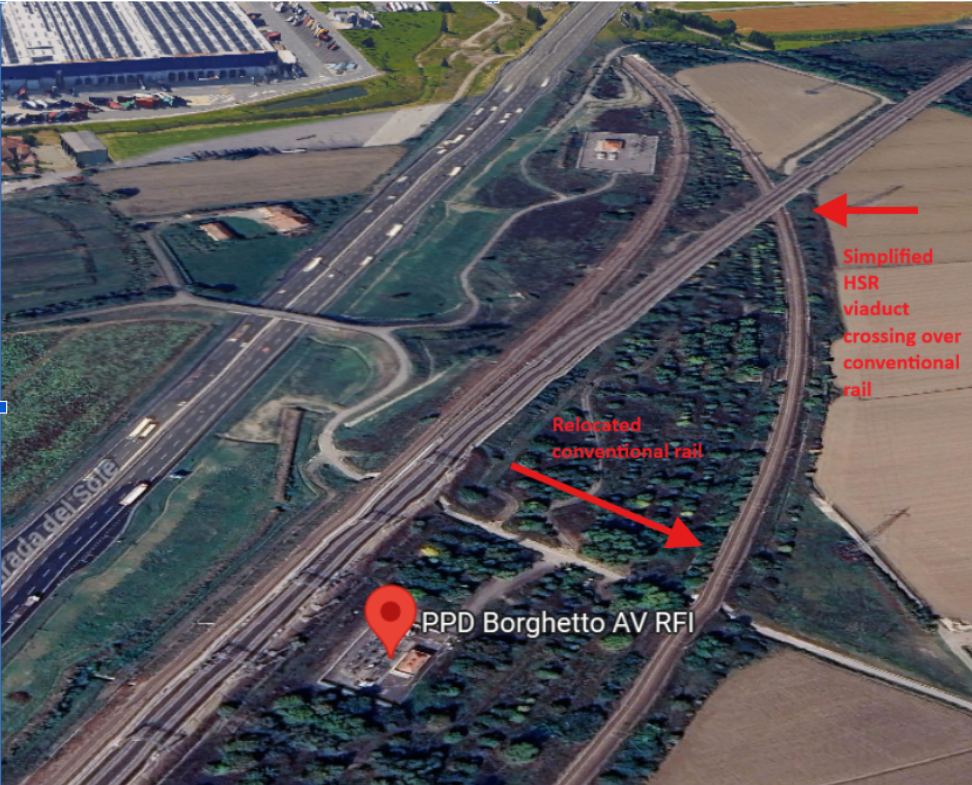
When high-speed rail is forced to cross conventional rail at shallow angles it requires larger and longer structures that are more expensive. The recently completed Tule River Viaduct shows how large such structures can be.
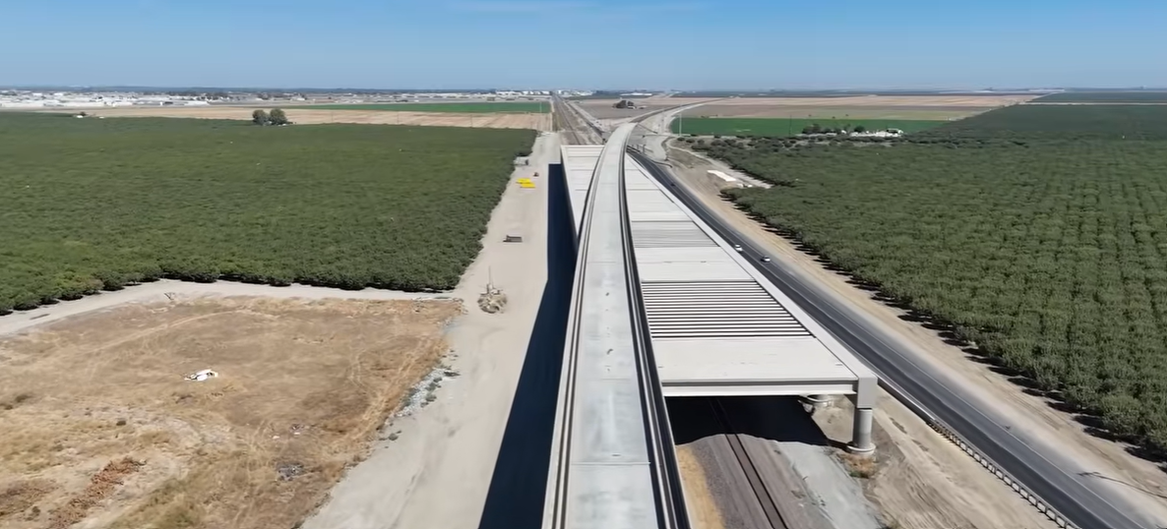
SNCF is able to facilitate these track shifts for conventional rail because the countries they work in outside of the US feature: 1) rail infrastructure owned by the state; and/or 2) rail infrastructure/service regulated by a strong civil service. The state largely does not own the infrastructure in the US and its relatively weak civil service for rail regulation is divided between the FRA and STB.
CAHSR was able to convince BNSF that shifting its track slightly would incur less operational headaches during construction and maintenance than large overhead structures. But this only occurred after BNSF experienced the headaches of building shoeflys, flagging and slow orders during the construction of several large structures like that of the Wasco and Tule viaducts. The recently completed CP Bowles track shift shows how much simpler a track shift makes the Manning Avenue grade separation in the distance.
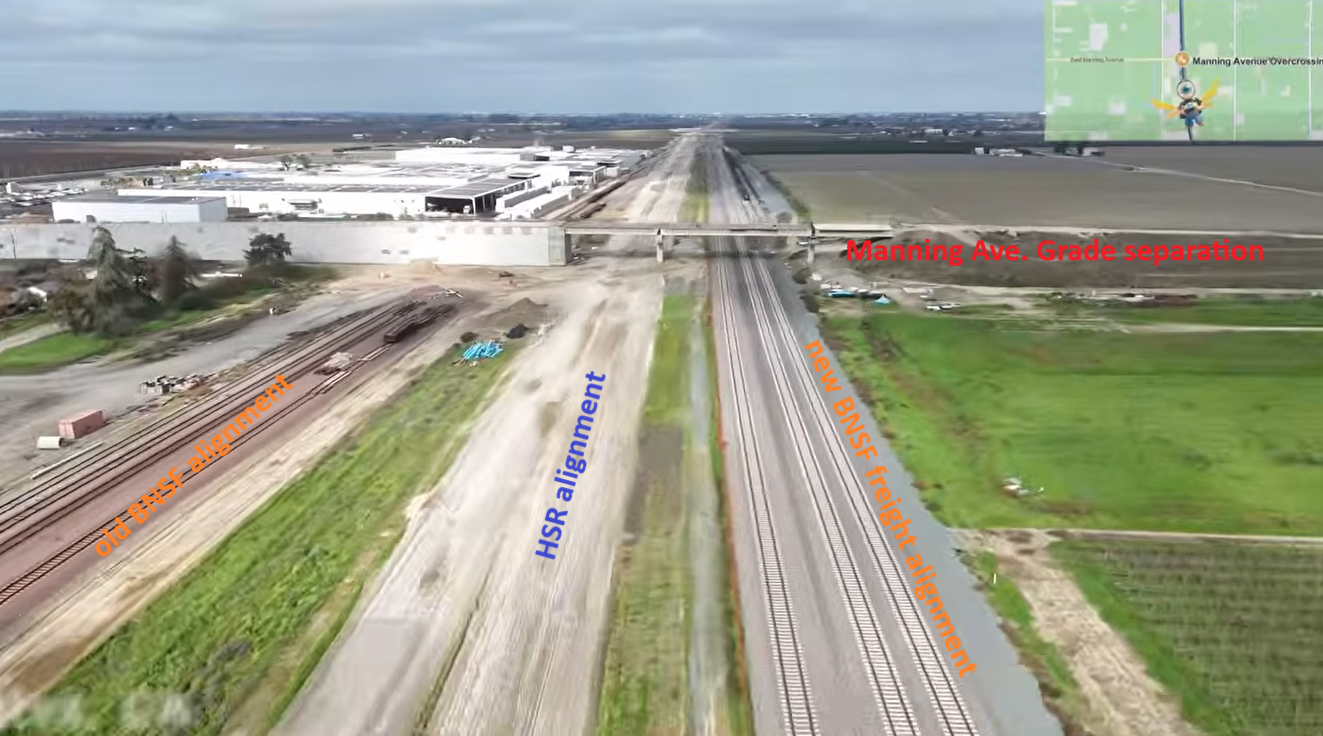
Possibly SNCF would have been simply more convincing in the need for simple track relocations to UPRR and BNSF and could have avoided many expensive structures. Based on other experience, however, Class 1 railroads rarely are interested in or quick to adopt international best practices.
That same level of optimism extends beyond railroad cooperation. SNCF proposed to hold meetings with highway and roadway agencies (aka Caltrans and local governments) as well as utility companies to advance the design. Clearly SNCF was not familiar with California’s fragmented, tortuous decision-making environment when it comes to infrastructure development and approvals - where meetings are endless, standards and requirements constantly change and there is no timeline or even objective basis for approval. Take the City of Shafter’s recent decision to approve a sprawl subdivision in the middle of the CAHSR alignment - an alignment with a full, approved CEQA EIR since 2015, the City of Lancaster’s approval of a massive warehouse development directly in the CAHSR alignment last year, or the North Kern Water Storage District's decision to violate their written agreement to relocate a 400 foot section of a canal to facilitate CAHSR guideway after previously approving the relocation plan.
-
- Interfaces with the appropriate stakeholders and the relevant highway and roadway agencies as regards grade separation: SNCF will establish a specific organization to take charge of handling discussions, negotiations, design, work schedules and construction management.
- Interface with utilities companies over utility protection and relocation: A similar form of organization will be adopted.
-SNCF 2010 Proposal pg. 49
A hint of SNCF’s experience with a more orderly design development with third parties shows up on page 233 of their proposal where they reference the “Declaration of Public Utility” or DUP. This is an administrative process used by mostly Civil Code (Code Napoleon) countries for determining route planning, preliminary designs, environmental impacts, third party impacts and identifying conflict avoidance, resolution or mitigations. In Spain it is also a Declaration of Public Utility (Declaración de Utilidad Pública), in Italy it is called a Conference of Services (Conferenza Di Servizi) or in Germany a Plan Approval Procedure (Planfeststellungsverfahren). Impacted parties, including infrastructure owners, are invited to review planning documents, identify impacts and work with the proponent to resolve conflicts or mitigate them. Importantly these discussions, plans and responses are conducted transparently. Typically an executive decision is rendered based on the evidence and those unhappy with it have limited appeal rights. This means that after a declaration of public utility, high-speed rail infrastructure can proceed expeditiously and in an orderly manner. There are verifications as designs near completion to ensure they comply with objective requirements and mitigations identified in the Declaration of Public Utility but there is no permit haggling.
Over the years, the protection of the environment has become one of the prime issues in the development of projects for new infrastructure in France. It is now taken into account from the conceptual design stage. It is one of the sensitive issues in the public debate and affects conceptual route selection at the preliminary study stage. The avoidance of environmental impacts is also the subject of a specific basic design file which is constantly interlinked with the technical one. The commitment of environmental best management practices (BMP’s) is one of the keystones of the Declaration of Public Utility. It is an important step taken by the project sponsor in regard to gaining the support of interested stakeholders.
- SNCF 2010 Proposal, HSL Environmental Design
As you may expect, California does not have a declaration of public utility process. Instead projects must go through an open-ended CEQA process where anyone can suggest alternatives (that must be studied) or demand mitigations (that are functionally required) lest they trigger an open-ended lawsuit(s) potentially enjoining construction for an indefinite amount of time. Third party impacts are handled through siloed, bilateral agreements that provide tremendous leverage and opacity to negotiations with railroads, utilities and local governments to demand unreasonable and extractive concessions to proceed. When local governments or utilities seem poised to demand expensive relocations or phasing as a condition of their discretionary approvals, the natural tendency of rail/transit designers is to seek additional land acquisition to hedge against this tendency - which ends up adding further time and cost to projects.
All that to say, California should probably have a Declaration of Public Utility process for CAHSR and other transit projects to ensure timely, transparent and cost effective approvals. SNCF’s 2010 proposal implicitly understands that in California - unlike in other developed countries - they are at the whims of railroads, utilities and oppositional local governments and at best must seek their cooperation. That’s not a knock on SNCF, but it does show the limitations of what a private operator can do in an unfriendly institutional environment.
Funding and Project Management
The SNCF 2010 Proposal is an interesting historic document that provides a look into many of the assumptions, hopes and aspirations of SNCF, CAHSR and national high-speed rail proponents prior to the 2010 congressional elections. In reading the SNCF 2010 Proposal it is clear that it is addressed as much to the FRA as it is to CAHSR.
Prior to 2008, FRA was primarily focused on rail safety. With the passage of the 2008 Passenger Rail Investment and Improvement Act, the US DOT delegated grant making authority for intercity rail to the FRA. In 2009 the American Recovery and Reinvestment Act (ARRA) allocated $2.5bn for intercity rail. Suddenly FRA was tasked with getting money out the door to support high-speed rail corridors in Florida, Ohio, Wisconsin and California. The FRA envisioned itself as being an integral partner in the development of these corridors, supporting planning, environmental review, preliminary design and procurement each step of the way. This was called the High-Speed Intercity Passenger Rail Program.
"FRA should strongly consider assembling a designated team consisting of individuals with backgrounds in HSR project design to assist the implementation of the HSIPR Program. Additional resources – in terms of manpower and expertise – will be necessary to evaluate proposals and to draft the standards and regulations necessary for the successful roll-out of the program. Specialized teams may also be necessary to advise recipients of HSIPR Program funding on best practices. Selected respondents to this RFEI could fulfill one or all of these functions."
-SNCF 2010 Proposal, pg. 74
The SNCF 2010 Proposal suggested that FRA hire experienced high-speed rail personnel to guide the development in national high-speed rail corridors. With the 2010 Congressional elections, plans for an expanded FRA to support intercity rail development via the High-Speed Intercity Passenger Rail Program went on ice. In turn Ohio, Florida and Wisconsin rejected ARRA funding, leaving California as the sole beneficiary of the ARRA grants. Certainly this provided a short term benefit for CAHSR but the benefits and constituency for further intercity and high-speed rail development dwindled.
"7.a.1 Authorize and create a sponsoring entity for the project
The U.S. Department of Transportation, Federal Railroad Administration (FRA) HSIPR Program will coordinate state efforts, administer the federal capital fund for corridor development, and lead the establishment of HSR at the federal level. Recognizing the progress made by FRA (especially in light of the urgency of ARRA’s funding timelines) a need exists for additional personnel with backgrounds in HSR to assist FRA in administering the program and evaluating the expected high-volume of proposals. Although FRA and Amtrak recently introduced intercity passenger rail metrics as required by PRIIA §207, FRA lacks proven metrics to quantify many of the HSIPR Program evaluation criteria, such as “economic recovery benefits,” “sustainability of benefits,” and “transportation benefits,” all of which will be necessary to objectively weigh applications. In addition to creating new measurement tools, additional steps are necessary to ensure that HSR grant funds are allocated to sustainable projects. The creation of a dedicated “national infrastructure bank” would facilitate the non-political, objective allocation of HSIP Program funds. See section 9(e) for a discussion of this proposal."
-
- SNCF 2010 Proposal, pg. 72
Note also the proposal for a National Infrastructure Bank to provide “non-political, objective” allocation of funding/financing for “sustainable” (read commercially viable) high-speed rail projects. The Build America Bureau, established in 2016, directs financing for transportation infrastructure, including rail, under the auspices of the Secretary of Transportation. Sixteen years later a mere study of a standalone and politically-insulated National Infrastructure Bank is included in the Build America 250 House Transportation & Infrastructure markup of the Surface Transportation Re-Authorization.
For an extreme example of the difference between politically-directed versus non-political allocation of funding for rail, check out the August 14, 2026 press release from the FRA announcing rail grants under the National Railroad Partnership Program:

Related, the SNCF 2010 Proposal assumes that the FRA will fund commercially viable phases to start. It suggests starting with San Francisco to Fresno as an initial operating segment, and then extending south from there. The 2026 Business Plan indicates the SF/SJ to Bakersfield service would be operationally profitable, which tends to underscore this analysis.
Instead, the Obama FRA mandated through its ARRA grant that CAHSR start in the Central Valley - a commercial unprofitable project section by itself - in order to address Great Recession unemployment and air quality issues.
The SNCF 2010 Proposal further makes recommendations that the FRA mandate the streamlining of state procurement laws to facilitate lower costs and obtain more experienced contractors and operators. The proposal also asks FRA to keep a close eye on the Buy American waiver implementation to ensure states are not creating a pure “Buy American” requirement.
On the topic of public funding the SNCF 2010 Proposal is even more direct: public funding, including Federal funding, is required to achieve a HSR network.
"HSR programs will require extensive public funding until systems become self-sustaining. FRA has acknowledged that $8 billion is an “initial down payment” on a national HSR system. The massive infrastructure and rolling stock investments necessary to begin HSR operations on a single corridor will require significantly more federal investment. Once systems are in place, additional subsidies may be necessary until ridership reaches a level where sustainability is achieved. In consideration of states’ precarious budgetary situations, as well as the scale of the required investment, the majority of funds will necessarily originate from the federal government. Even in states where a political will exists, multi-billion dollar state investments may be impossible."
-SNCF 2010 Proposal, pg. 75
After the 2010 Congressional elections, all further appropriations for high-speed rail development from the federal government stopped. This was only reversed in 2021 with the passage of the Bipartisan Infrastructure Law, which provided 5 years of advanced appropriations for $66bn for intercity rail. CAHSR received $3.1B in federal funds under the BIL, only for the Trump administration to cancel the grants a year later.
The SNCF 2010 Proposal also includes recommendations for the Railroad Rehabilitation and Improvement Financing (RRIF) program, including longer payment terms, expanded capacity and eliminating Buy American requirements. The RRIF program has been expanded to $35bn, but the Trump I, Biden and Trump II administrations have been slow to deploy capital. Trump II has been particularly hesitant to pull the trigger on a RRIF loan to its favored Brightline West program. Recently the Center for Public Enterprise released a white paper called the Transit Infrastructure Lottery calling on further reforms to RRIF to support state capacity and rail electrification.
Another issue raised by the SNCF 2010 Proposal is permitting: “[t]he myriad of such federal, state and local permits, and the diversity of issues considered, is extensive.” SNCF presumes that some permits will be “pre-empted” presumably under the Surface Transportation Board’s ICCTA preemptive powers.
"8.c.2 Compliance with Federal, state and local requirements
SNCF’s experience with projects of this magnitude demonstrates the importance of organization, including the development and implementation of project permitting checklists. The myriad of such federal, state and local permits, and the diversity of issues considered, is extensive. A coordinated effort is essential. An initial determination by the rail authority of the permits “pre-empted” by its jurisdiction may reduce permitting requirements. However, even if permits are pre-empted, in the spirit of governmental respect and cooperation, the HSR proponents would consult with these agencies regarding the HSR project and the agency’s support for, and any concerns related to, the proposed HSR project."
-SNCF 2010 Proposal, pg. 78
CAHSR initially sought to comply with local permitting under pressure from the Legislature. Only after experiencing multiple CEQA lawsuits from landowners and GOP-backed interests for the Fresno to Bakersfield EIR in 2014 and racing to start construction by the ARRA grant deadline of 2015 did CAHSR seek a declaration of preemption from the STB. The STB subsequently declared CAHSR preempted from state laws in late 2014.
But in 2017 the California Supreme Court resolved that CEQA and local permitting does apply to railroads owned by California public entities irrespective of the STB rulings. Governor Jerry Brown and Attorney General Xavier Becerra ultimately declined to appeal the ruling to an unfavorable US Supreme Court - both due to the chances of losing and under pressure from Central Valley and some Peninsula interests to constrain CAHSR.
Hindsight is clearly 20/20, but the SNCF 2010 Proposal illustrates that SNCF itself was counting on key political, institutional and financial dependencies. Certainly SNCF’s early involvement could have helped on balance, but there is no way tapping SNCF in 2011 would have overcome the zeroing out of FRA’s plans for high-speed rail state capacity, Congress zeroing out capital funding for high-speed rail or an adversarial Legislature intent on making CAHSR run the CEQA gauntlet irrespective of Federal preemption.
SNCF in 2010 vs 2026
What exactly did SNCF propose in 2010/2011 in terms of private participation and investment? A procurement and development process by which SNCF, in collaboration with engineers and financiers, would develop service concepts that would turn into negotiated concessions to build and run service.
The process proposed by SNCF in October 2010 for private operator participation looks eerily similar to the one proposed by MAP (including SNCF Voyageurs) and CAHSR in June 2026.
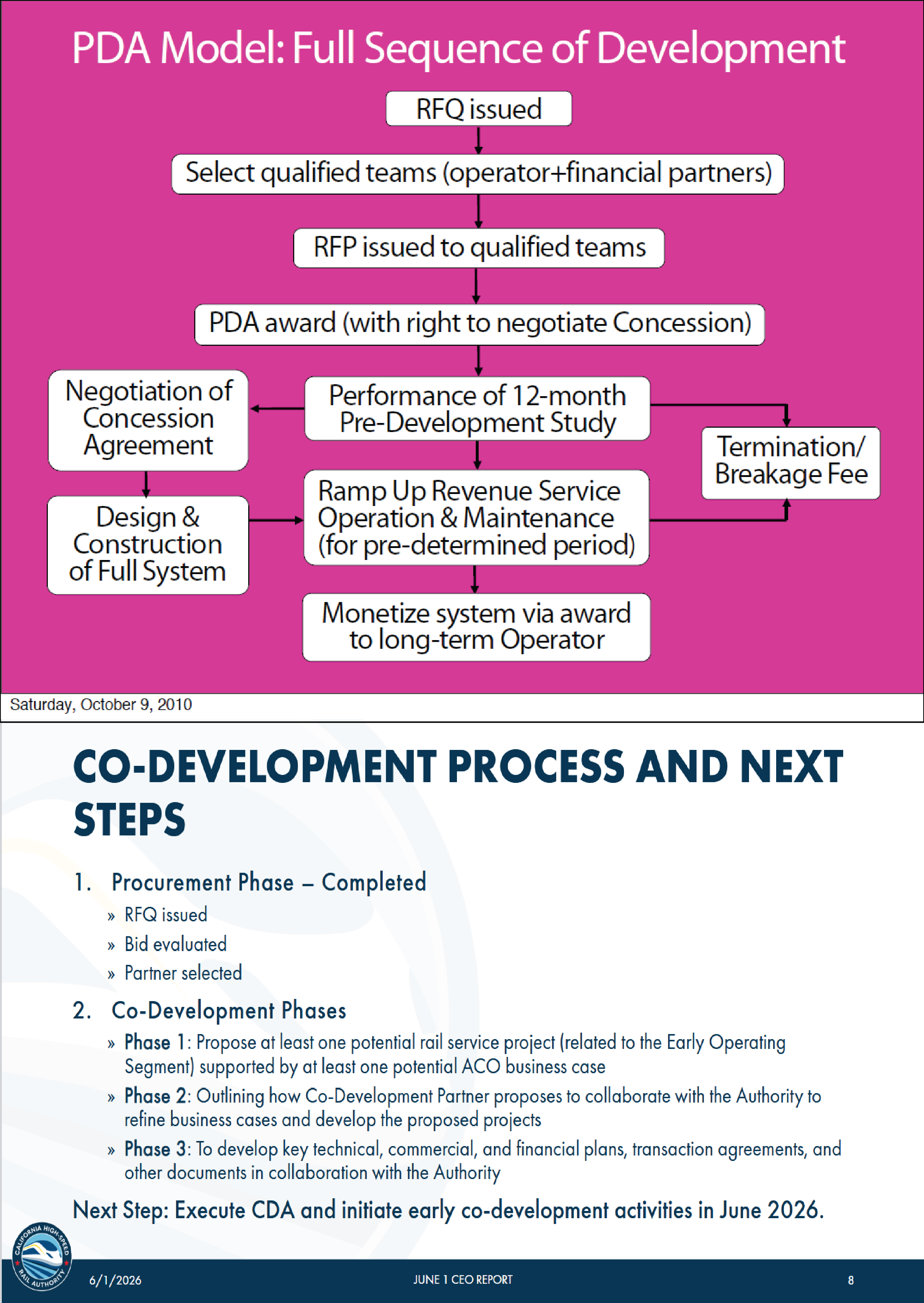
What changed since 2011? Reliable funding. In 2011, CAHSR had only the $9.95 B bond (at the time, tied up in lawsuits and unable to be spent) approved by voters in 2008, less than ⅓ of the original budget estimate, on hand. By contrast, Morocco’s Al Boraq high speed rail was fully funded when SNCF began work. California eventually began to fix this problem with the Cap-and-Trade program which provided some yearly funding of 25% of revenues, which was improved in 2025 with the ‘Cap and Invest’ deal that provided a fixed $1B/year guarantee. (Unfortunately, recent changes from CARB to the auction credits in May 2026 to provide a subsidy to oil refineries for “decarbonization” has led to a situation which is now pitting GGRF revenue recipients and their various interests against each other. While the Legislature did not reduce the guarantee in the budget deal approved for FY2027, the conversation will undoubtedly be resurrected next year in preparing for FY2028 and beyond.)
One could reasonably expect Walters, Matthews and other pundits to say “better late than never” when it comes to CAHSR listening to SNCF’s vast experience in delivering high-speed rail globally. Unfortunately these pundits and, perhaps, separately opponents of the project have decided that simply “never” is the preferred outcome.
There is one anecdote from Ralph Vartabedian’s NYT 2022 piece that rings true.
“‘There were so many things that went wrong,’ SNCF project manager Dan McNamara told Vartabedian. ‘SNCF was very angry. They told the state they were leaving for North Africa, which was less politically dysfunctional. They went to Morocco and helped them build a rail system.’”
The disinterest from the Legislature and Administration in seriously addressing the obstacles to high-speed rail and transit construction generally in California is absolutely spot-on. Many legislators will gripe about the delays and cost overruns of CAHSR or another transit or rail project in different legislative districts. But they become cheerleaders when the delayed and over budget transit projects in their districts need approvals, streamlining or funding.
The problems that afflict CAHSR - overreliance on consultants, committing early to plans before significant design is complete, extortionate and slothful utilities, partial funding, infrastructure-heavy solutions, failure to share infrastructure instead of coordinate with existing operators - also afflicts local and regional transit construction throughout California. These general problems require general solutions.
The preferred solution of Matthews, Walters and other pundits - the cancellation of CAHSR (ostensibly) to redistribute its funding to local transit projects - will not solve the underlying challenges associated with transit and rail costs in California. It may make them slightly less visible and distribute the odium with high infrastructure costs a bit wider. The timing of these pieces seems intended to undermine CAHSR’s annual guarantee in Cap-And-Invest which was under active debate at the time. Thankfully, CAHSR’s funding survived, for now - but as long as media is biased towards old and inaccurate information, CAHSR will remain under threat.
Truly fixing these problems will require the State of California and regional leaders to actually care about fixing them broadly - not just for a pet project. The first step they could take is resuscitating Senator Wiener’s SB 445 or something similar to address permitting issues. And unlocking financing through revenue bonds for CAHSR. And providing state capacity for the planning and early design of transit and rail projects. Improving transit and rail project delivery has broad benefits. There’s no time to start like the present.