Who's really behind CAHSR's slow pace?
As the 2026 California Governor's primary wrapped up, Xavier Becerra, leading democratic candidate, when asked about California High-Speed Rail, stated that he would “scrap the current configuration… and make sure we finish… but we’ve got to do it on budget and on time.” For people familiar with infrastructure projects, much less CAHSR, completely re-designing a project environmentally cleared and planned is unlikely to decrease delays or cost overruns.
There are real fixes and help that the Governor of California could provide to CAHSR in delivering service. But they require asserting authority on behalf of the state to prioritize benefits and minimize costs on behalf of the state.
We’ve written previously about how the CEQA process can be used to hold back electric rail - including a specific instance of CEQA abuse in Atherton aimed at preventing CAHSR from running on Caltrain right of way. We’ve also covered, at a high-level, some of the political challenges holding back the project. Over the past month three instances have highlighted parochial interests have added delay and cost to the already-challenged California High-Speed Rail program.
First, the Chronicle’s Rachel Swan reported on how the Cesar Chavez Foundation and allied interests used the CEQA process and political muscle to force the CAHSR to accept a $1B diversion from the existing Tehachapi Pass rail alignment to avoid aesthetic and visual impacts to the grave site of labor leader Cesar Chavez at Cesar Chavez National Monument. In March 2026 it was reported widely that Cesar Chavez sexually assaulted and raped women during his career - leading to a widespread reckoning with his legacy that has impacted Chavez memorials around the state. Thankfully several CAHSR Board members have expressed an interest in re-opening this decision to save time and money for the program.
Further north, KGET in Bakersfield reported last week that the City of Shafter approved a sprawl subdivision in the middle of the approved Locally Generated Alternative environmentally-approved alignment for CAHSR near 7th Standard Road over the objections of CAHSR officials. The Mayor of Shafter official is quoted in the article as saying “[i]f you want to work with the city, these are conversations they should have done five years ago, 10 years ago, 15 years ago — that isn’t the case.”
To be clear, CAHSR started planning this section in the mid-2000s and environmentally reviewing this section in 2011. A full EIR was approved in 2014. Subsequently a new environmental document was circulated as a “Locally Generated Alternative” at the demand of Kern County interests. That Locally Generated Alternative was ultimately approved and then challenged under CEQA by the City of Shafter. The City of Shafter settled with CAHSR in 2018 with the stipulation that CAHSR grade separate not only their own alignment (as planned) but also grade separate freight railroad BNSF, which has existed in the City of Shafter for over 100 years. Clearly CAHSR has planned this alignment near 7th Standard Road extensively over the past 20 years with the active involvement of the City of Shafter.
100 miles further north, the Mayor of Fresno Jerry Dyer gave an interview to KMPH this past week opposing a concept being discussed in the legislature to provide CAHSR with tax increment financing powers around its stations. The idea of borrowing against future property tax and commercial revenues to help fund and accelerate rail and transit construction - is a global best practice in Europe and East Asia that aligns service enhancements with local economic development.
Closer to home Mayor Dyer told CBS47 “[b]ut any percentage, we’re not willing to negotiate” on sharing the tax upside of CAHSR bringing mobility and economic development to Fresno. Dyer continued that property tax growth is already being factored into the general fund to close future deficits.
Given that high-speed rail service is not scheduled to start until 2032-2033 and any increased increment would start from that date, it’s unclear how Mayor Dyer and Fresno are banking on increased property tax revenues due to high-speed rail service to cover budget deficits in 2027-2031. Finally, that property tax increment could by CAHSR be used to accelerate construction of connections to the Bay Area and LA County, and thereby further increase the value of sites near Fresno Station. Ideally Fresno would be aligned with that goal but doesn’t seem to want to have any skin in the game.
In all three of these instances we see narrow, parochial interests use California institutions, veto points and processes to slow down, add costs or hoard benefits for themselves. It’s another example of domestic worst practices undergirded by a simple principle: the interests of local elites trump the statewide interest.
As hinted above, the California legislature and governor are considering changes to shift the balance of power towards delivering high-speed rail. These include:
- Streamlining permitting of CAHSR-infrastructure by local governments to prevent delays and extortionate demands
- CEQA streamlining for CAHSR optimized infrastructure to reduce scope of legacy decisions from exactions and delays
- Tax increment financing around CAHSR stations to accelerate delivery and align service with economic development
- Dedicated court resources to speed up eminent domain cases in counties where judges are golf buddies with landowners
- Clear, objective rules and timelines for resolving CASHR infrastructure conflicts with utilities, including investor-owned utilities and water districts
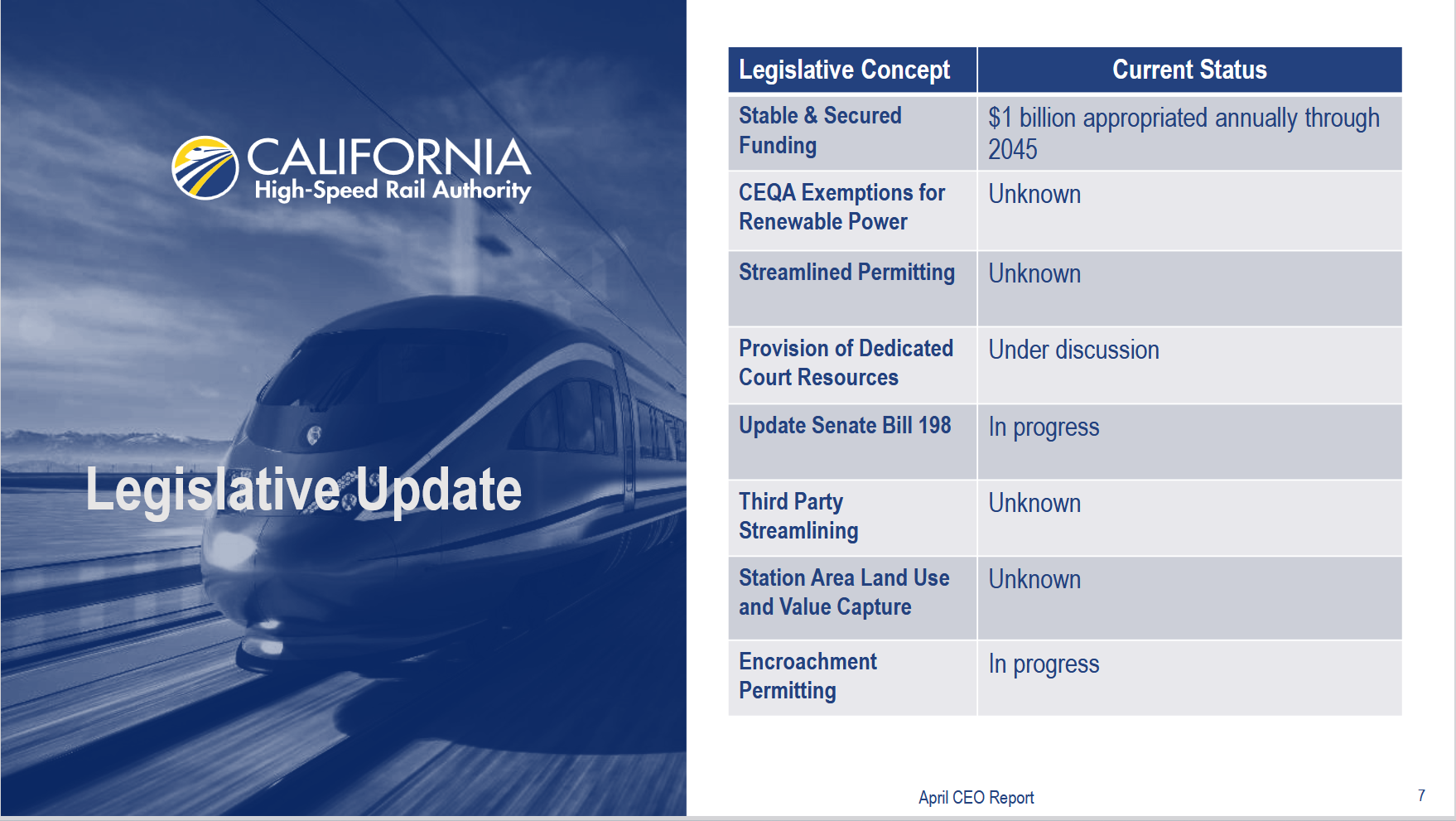
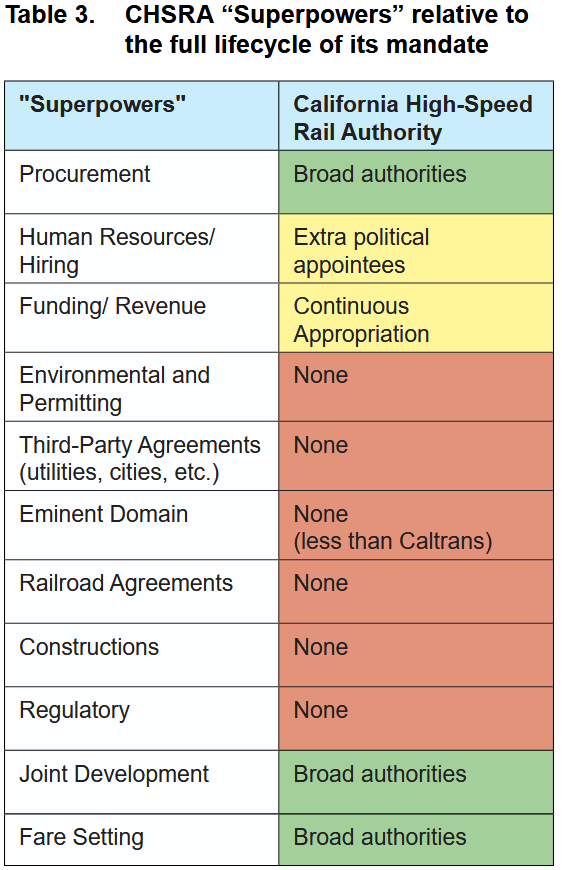
Unfortunately the Governor and Legislature have not fully embraced these concepts. As the Mineta Institute report on Mega-Project Delivery shows, successful large projects often have certain jurisdictional super-powers. While CAHSR already has some, it is missing key powers that can help provide schedule and budget certainty.
As articulated by CAHSR board member Emily Cohen:
There's so many questions out there from Californians, from Americans, from everybody about why is this project so hard? Why has it fallen behind?
How has it gotten so expensive?
High-Speed Rail is not in charge of every component of building this project, and when you look at this legislative package I sure hope elected officials are listening.
If this doesn't get done, costs go up, way up. And so we need our elected officials, and we need constituents to, to make noise about how important this is for getting this project done.
High-speed rail does not have control over this. These are the things that have to change at the state level.
Californians are desperate for this kind of reform on, on a lot of things.
But I just wanna call attention to how important this legislative package is, as I understand it, to this project. We will fall more behind. This project will become more expensive if we don't get these things done, and I just don't want us to lose sight of that.
Will the California legislature and our next governor take up the call?