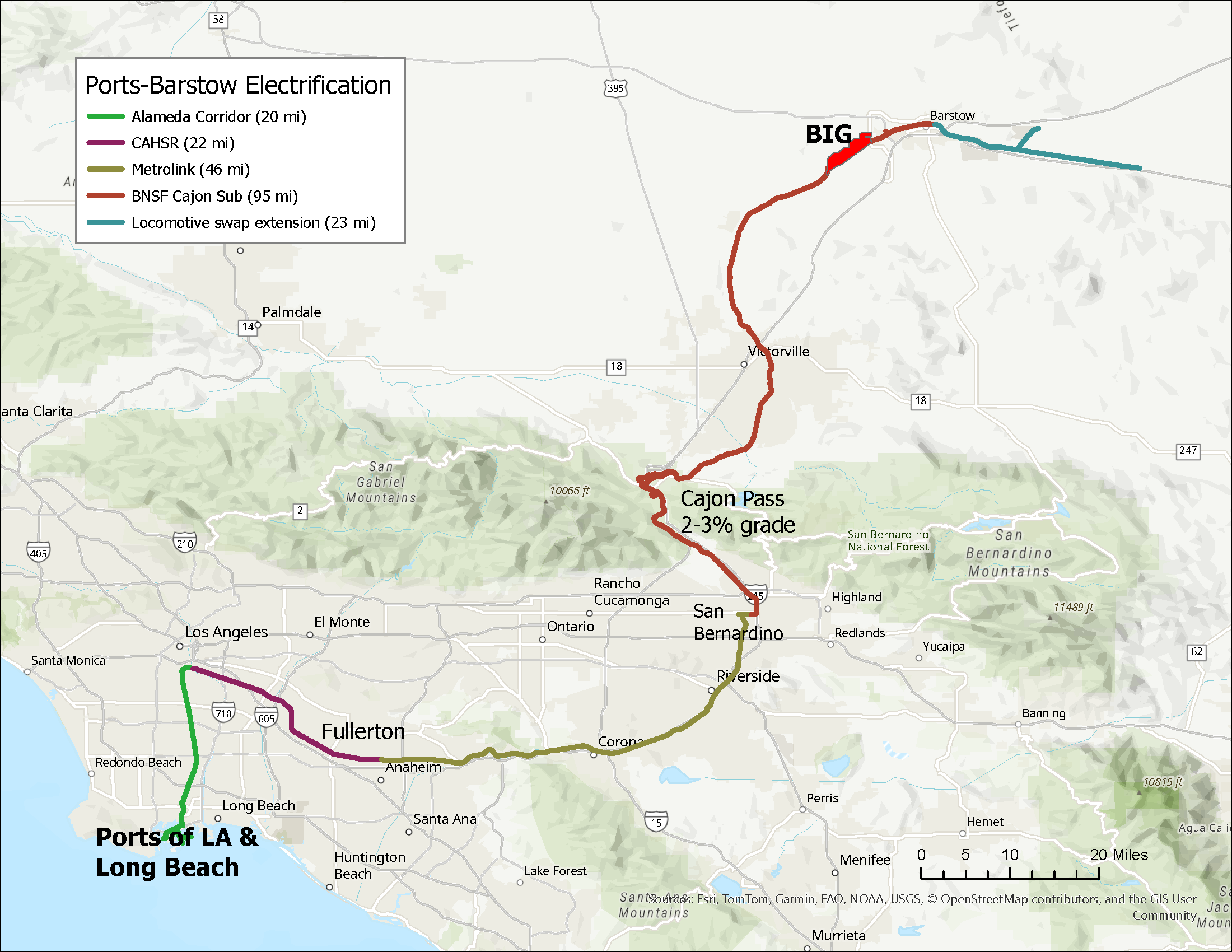
BNSF is proposing to build a massive new rail facility in Barstow called the Barstow International Gateway (BIG). Separate from BNSF’s existing Barstow rail yard, the BIG would be an intermodal facility with rail-oriented warehouses and a solar field in addition to block-swapping and transloading facilities. It is projected to add up to 16,000 jobs - nearly doubling the population of Barstow - and once complete would be the largest rail facility in the US at nearly ~5,000 acres. Once the project is built, Barstow will be a very different place.
The project is intended to alleviate freight traffic in the LA basin by redirecting truck trips and warehouse growth away from the ports and Inland Empire to Barstow, about 100 miles inland in the Mojave Desert. As such the project will increase rail traffic by 15-20 trains. Trains are cleaner than trucks, and we would love to see mode shift to rail. But it’s unclear whether this project would actually replace truck trips, or just add more trucks in new places. A table in the Errata section of the final EIR admits that the project is expected to increase diesel use by at least 3 million gallons per year.
The project EIR indicates that “criteria” air pollutants, which cause cancer, asthma, and high blood pressure, and kill about 8000 Californians per year, would exceed regulatory thresholds in Barstow - and in Los Angeles, Orange County, and the Inland Empire if truck traffic does not go down as promised. All of these impacts stem from BNSF’s failure to commit to any zero-emissions technology for the most significant sources of pollution: line-haul locomotives, switcher locomotives, and trucks.
While as proposed the BIG promises more pollution, it’s the perfect opportunity to clean up freight not just in Barstow but throughout Southern California. BNSF’s Southern Transcon from the ports to Bartow is one of the most highly-trafficked rail corridors in the country. This route includes the Cajon Pass, which has steep (for freight rail) 2-3% grades, contributing to San Bernardino County’s status as the county with the US’s highest rail sector emissions. Electrifying the ports to Barstow would save BNSF money and reduce their reliance on fossil fuels during an energy crisis, while reducing emissions in nearby communities.
BNSF has dismissed electrification as infeasible due to the challenges with electrifying the entirety of thousands of miles of the national rail network. However, the BIG makes electrifying a smaller ~200 mi segment from the ports to just past Barstow much easier. This would deliver dramatic emissions reductions to some of the most impacted communities, while serving as Phase 1 of a rolling program to gradually electrify the entire network long term.
BNSF plans to operate a freight shuttle service between the ports and Barstow using a dedicated fleet. These could operate 100% on wires. Additionally, electrifying out to Yermo and Newberry Yards provides space for long-distance trains to swap electric locomotives for diesel to continue on unelectrified cross-country segments, away from communities. By electrifying only about 200 miles of track, BNSF could operate most of their Southern California trains in zero-emissions mode, substantially reducing impacts in a region that has the nation’s worst air quality.
Electrifying the ports to Barstow would also have substantial benefits for Southern California rail passengers. The Metrolink IE-OC, 91/Perris Valley, and part of the Orange County Lines share track with the BNSF Southern Transcon, and are planned for electrification in the 2024 State Rail Plan. But there are no near-term plans to do so because BNSF controls the right of way. Electrifying the ports to Barstow could accelerate Metrolink electrification - and faster, more frequent service to Riverside, Anaheim, and Oceanside.
Co-benefit with passenger rail and public right of way helps nullify BNSF’s other objection to electrification: the cost. The Alameda Corridor, the first leg from the ports to Barstow, is publicly owned, while BNSF has already agreed to allow the California High-Speed Rail Authority to electrify two tracks, to be shared by both passenger and freight trains, from Los Angeles to Fullerton, entirely on BNSF-owned right-of-way. A recent paper also demonstrates that electrifying the ports to Barstow is equally or more profitable for BNSF than continuing to run diesel trains. By sharing the costs, the public would benefit from cleaner air and better transit, while BNSF benefits from more powerful, cheaper to operate electric trains.
Electrification of the ports to Barstow has been studied extensively and found feasible - by SCAG, by Metrolink, by the US Department of Energy, and by us (Alameda Corridor study, LA-IE study, Cajon Subdivision Study). Bridge clearances are not an issue, and there are plenty of substations near the right of way that could be used to power the overhead wires. To learn about this proposal in more detail, read our comment on the BIG’s Draft EIR.
The Barstow Planning Commission will vote on whether to approve the Final EIR and General Plan on Saturday, May 16th at 1 pm. A full vote by the city council is expected on June 2nd at 6 pm. Both meetings are in person in Barstow. If they approve the EIR, the BIG moves forward with no electrification and no mitigations. But Barstow has the power to reject the EIR and send it back - this time with plans for electrification. This project affects all of Southern California, and the City of Barstow needs to hear from you that the BIG must be electric.